

Inside the Freedom Plane Exhibit at the Museum of Miami
If you’re arriving in Miami before your cruise or spending an extra day in the city, there’s a limited-time opportunity to experience one of the nation’s most significant traveling history exhibits.
Through July 5, the Museum of Miami is hosting the Freedom Plane National Tour, bringing together nine original Founding-era documents from the National Archives. Miami is one of only eight cities on the nationwide tour before the exhibit continues to Dearborn, Michigan, and concludes in Seattle during Alaska cruise season.
For cruise travelers, that makes Miami and Seattle two ports where you can pair a cruise vacation with a rare museum experience.
The Freedom Plane National Tour is part of the upcoming America250 commemoration and gives visitors the opportunity to see original founding documents outside their permanent home in Washington, D.C. I visited the exhibit to see what the experience was actually like.

A Familiar Museum with a New Name
This wasn’t my first visit to the museum.
I was there many years ago, when it was still called HistoryMiami Museum. Earlier this year, the institution adopted its new name, Museum of Miami, while continuing its mission of preserving and sharing the stories of South Florida.
The museum is part of the Miami-Dade Cultural Center in downtown Miami and is easy to reach by free Metromover from Government Center Station.
Before you even enter the museum, the architecture makes an impression.
The Metro-Dade Cultural Center is built around a broad elevated plaza that rises above the surrounding streets. Walking across the courtyard, I couldn’t help thinking it felt almost like entering a modern fortress. The sounds of downtown gradually faded as I approached the museum.
I Though There Would be More… People
I arrived early because I knew the museum offers a limited number of free same-day tickets every day. You can also reserve an entry time in advance for a fee if you prefer guaranteed admission.
I expected larger crowds or maybe it’s because I was an early bird. The night before, Brazil and Scotland had faced off at a FIFA World Cup match, and my Metromover ride downtown was filled with families wearing colorful jerseys.
After checking in at the museum’s main building, I crossed to the north building, where the Freedom Plane exhibit is located.
A Warm Welcome
Just inside the north building, I was greeted by Jordan, a Museum of Miami guide.
He welcomed visitors, answered questions, and gave a thoughtful introduction to both the Freedom Plane exhibit and the other galleries in the building. His overview didn’t feel scripted. Instead, it gave me a better sense of what I was about to experience and made me want to return to explore the rest of the building after seeing the exhibit.
The Freedom Plane gallery is just to the right of the entrance.

Visitors wait in a short indoor queue until a museum staff member invites the next group inside. Many visitors paused at the large Freedom Plane welcome display before entering. Featuring signatures from the Declaration of Independence alongside a Miami skyline, it quickly became a popular place for photos.
Inside the Gallery
The first thing I noticed inside was how open the gallery felt.
Three display cases anchor the exhibit, each backed by large graphic panels that tell the story of America’s founding. The panels provide historical context while allowing the original documents to remain the unmistakable focus.
The layout is simple and easy to follow. Visitors naturally moved from one display case to the next. No one needed directions. The gallery is dimly lit to help protect the documents.

Visitors begin the Freedom Plane experience with a chronological look at the events that led to the Declaration of Independence. Photo: H. Liu Visitors view the Constitution and Bill of Rights section of the Freedom Plane National Tour at the Museum of Miami. Photo: H. Liu The Freedom Plane National Tour is on display at the Museum of Miami through July 5 before continuing to other U.S. cities. Photo: H. Liu

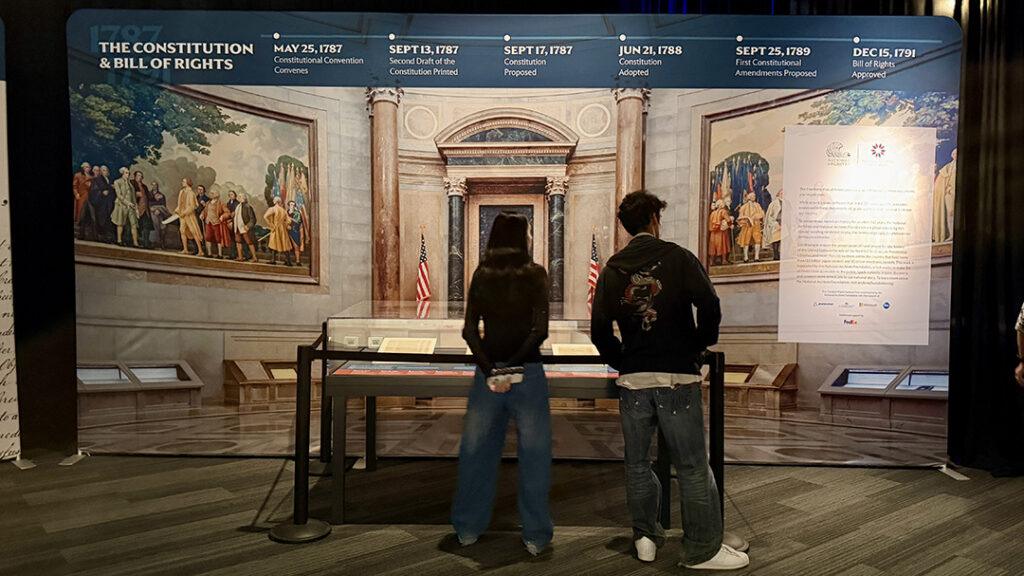
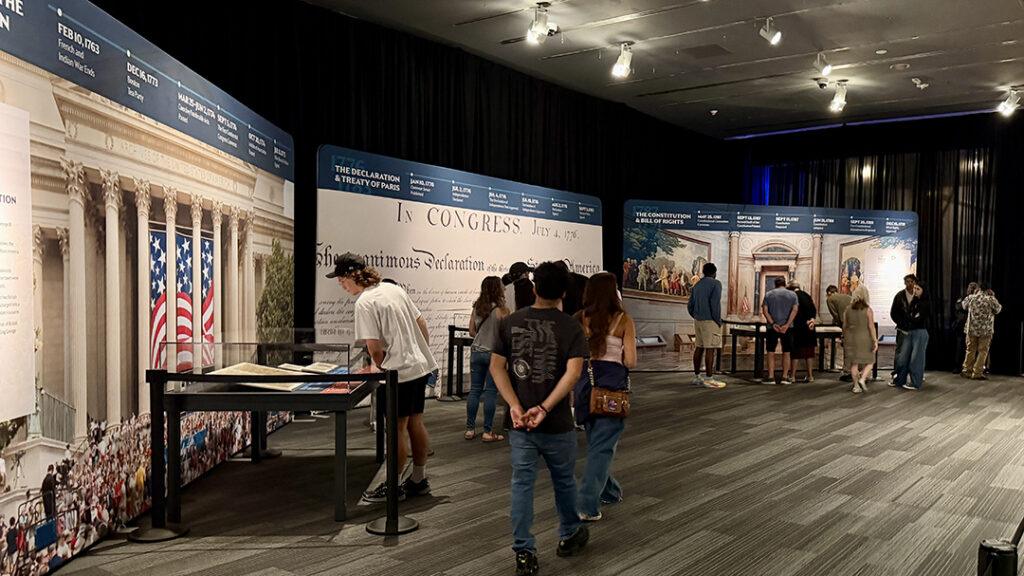
The atmosphere was reverent. People spoke quietly. They patiently waited for one another. If someone lingered at a display, others simply stepped aside until it was their turn.
Although each visit is limited to about 15 minutes, I never felt hurried.
The documents rest beneath protective glass at a relatively flat angle. One visitor quietly remarked that she wished the cases tilted a little more because, as a shorter person, she found them difficult to see.
I understood exactly what she meant.
I also wished I could have moved just a little closer. Not because I wanted to read every line, but because I wanted to see the texture of 250+ year-old parchment itself.
Books and photographs can reproduce the words. Standing a few feet from the originals is an entirely different experience.
An AI Guide That Extends the Visit
The exhibit also includes an AI-powered guide that visitors can access by scanning a QR code.
The online experience provides photographs, historical background, and additional information about each document. Best of all, it remains available after you leave the museum.
I appreciated that.
Rather than looking at my phone while standing in front of the documents, I chose to experience the exhibit first and save the deeper reading for later.
The AI guide became a continuation of the visit instead of a distraction from it.
Don’t Miss the Rest of the Museum
Jordan’s introduction had made me curious about the rest of the north building, so after finishing the Freedom Plane exhibit, I continued exploring instead of heading for the exit.
When I finished that building, I decided I might as well cross back and visit the rest of the museum as well.
I’m glad I did.
In all, I spent about an hour at the Museum of Miami. I didn’t stop to read every exhibit panel. Instead, I wandered through the galleries, taking in the displays that caught my attention and enjoying the museum at my own pace.
Throughout both buildings, I noticed families exploring together. While the Freedom Plane exhibit itself was quiet and reflective, the rest of the museum had a livelier atmosphere, with visitors of all ages discovering Miami’s history together.
If your schedule allows, plan to spend about an hour at the museum. The Freedom Plane exhibit may be the headline attraction, but it’s only one part of what the museum has to offer.
The Tour Continues
The Freedom Plane remains at the Museum of Miami through July 5 before traveling to the Henry Ford Museum of American Innovation in Dearborn. The national tour concludes at Seattle’s Museum of History & Industry from July 30 through Aug. 16.
For travelers sailing from Seattle later this summer, the exhibit offers one final opportunity to experience it before the tour comes to an end.


