

From Copenhagen to Bombay to Alang Ocean Liners
Italian Memory
“My father was an engineer working at Port Tewfik in Egypt. One morning [Dec. 1994], the Italian liner Achille Lauro appeared. My father took pictures of the ship as it passed by. It burned one or days later [off Somalia] and then later sank. Maybe they were the very last photos of that infamous ship!”

Back to the Italia
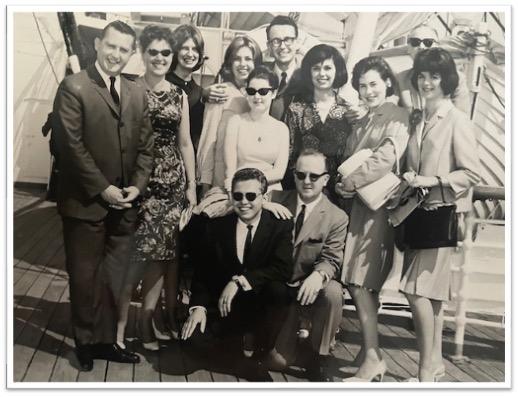
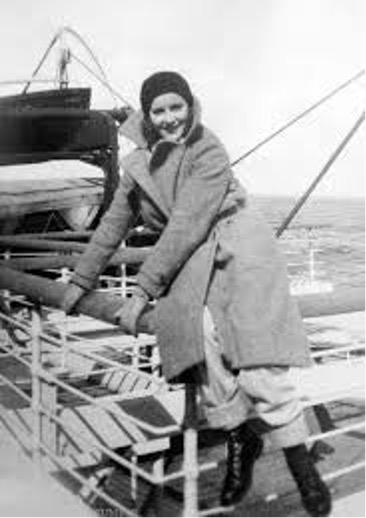
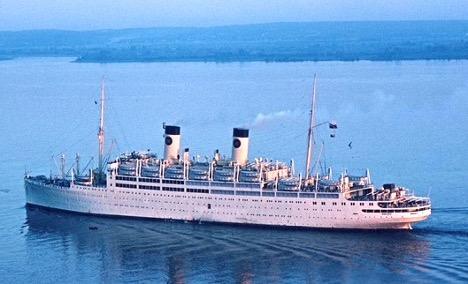
We mentioned this fine ship in a Dec. posting. Our good friend Dieter Killinger responded: “I did the 7-day Italia Nassau Cruise in June 1963. The entire North German Lloyd staff [where Dieter worked] gave me a farewell party. It was a delightful: 7 days — and 7 days of sun and seas like glass. Loved the old world decor of the ship! My aunt returned from England in 1947 on the John Ericsson, which was what the ship was called during WW II, and full of returning War brides. I can well imagine the ship in the Twenties and Thirties when she was the Kungsholm and the likes of Greta Garbo was a passenger.”

North German Lloyd staff pose onboard during a farewell voyage aboard the Italia, June 1963. Courtesy of the William H. Miller Collection. The Swedish American Line’s Kungsholm seen at Copenhagen in 1938, a sleek prewar liner later known as the Italia. Courtesy of the William H. Miller Collection. Greta Garbo, the Swedish-born Hollywood film star of the 1920s and 1930s, pictured aboard the Kungsholm in 1933. Courtesy of the William H. Miller Collection. A colorful Swedish American Line baggage label from the late 1930s. Courtesy of the William H. Miller Collection. The Italia seen on Germany’s River Elbe. Courtesy of the William H. Miller Collection.


Looking Through Some Old Files
The Buenos Aires-based Dodero Lines operated (in the 1950s and 60s) a trio of very fine passenger-cargo liners, the Argentina, Libertad and Uruguay, in regular South Atlantic service. The routing was from London via Le Havre and Lisbon (and sometimes Madeira) over to Rio de Janeiro, Santos, Montevideo and Buenos Aires. Leisurely and restful, London to Buenos Aires took just over two weeks.
Built in England in 1949-50, they were especially high standard for their time – carrying up to a clubby 96 passengers, all cabins – singles or doubles – had the then prized amenity of private bathroom facilities. And an added amenity: And there was air-conditioning in the public rooms and in the suites.

But before the fall of Juan Peron’s regime in 1955, the three ships had political names: Presidente Peron, 17 De Octubre and Eva Peron.

And I found this brochure as well: If, say, British travelers wanted to escape the dreary winter weather (back in Dec. 1955), they could sail out from London on the little Swedish liner Patricia to the sunny West Indies. While the 250-passenger ship remained in tropic waters, they could stay ashore but then book the return sailing (in the following April) to London. The round voyage was priced from $300.

The Patricia was yacht-like and later became Hamburg America Line’s Ariadne and still later the Ariane for Chandris.

Greek Memories
From up in Boston, longtime friend Larry Ryan wrote: “Thanks Bill for highlighting the Queen Anna Maria. As you may recall it was my very first 7-day cruise: October 1973 from Boston to Nassau and Freeport. Also, my first trip alone! I will never forget my family waving goodbye from Castle Island, as I felt the beautiful movement of the ship. The ship was beautiful, with great food and crew. As you have often said nothing ever matches the first. The back deck needed some repairs but it didn’t matter. Everything was totally new and exciting! Met wonderful people and some for life! I went again in 1975 to Bermuda and we had the adventure of rescuing a yacht in trouble. Then in 1977, but aboard the Carnivale (ex-Queen Anna Maria) and to Bermuda again. One of my favorites in the world!”

Trivia!
The toll for the Queen Mary’s passage through the Panama Canal was $650,000 (with extras, the final tab was $1.1 million. No, not quite the New Jersey Turnpike!) Altogether, comes to approx $400 each for 2,400 passengers onboard. Fifty one years ago, back in 1975, the toll for the QE2’s transit was $75,000, but which then of course seemed very impressive.

And while the Canal is very busy, it only contributes a mere 5% to the Panamanian economy. The rest comes from banking and offshore business holdings (including shipping).

Caribbean Skies
Philippe Brebant has found this view at Fort de France, Martinique of four long-ago liners gathered together in approximately 1966. The Olympia (left); then the Sagafjord, Nieuw Amsterdam, and Flandre.

Bombay & Beyond
A recent fellow passenger told me that his grandfather was a successful businessman in Bombay and sent his son (the father of the passenger) from Bombay to New York on the American President Lines. The ship was the 96-bed President Monroe according to family records and the four-week voyage was via the Suez Canal. The year was 1962. His father had extra luggage and was spending time at Yale University.

Travel Advisory
A passenger tells me she went to India to serve as a nurse and was based quite close to Alang and the famous scrapyards. While not quite, say, the Taj Mahal, she enthusiastically said: “You must go and see the ships die. It is fascinating!”


Two modern cruise ships beached at Alang, India, underscore the stark final stage of a vessel’s life in the global ship-breaking industry. Courtesy of the William H. Miller Collection.


