

Bremen, France, America & a Royal Call to Monaco
70 Years Ago
In April 1956, Hollywood actress Grace Kelly sailed from New York to a specially arranged stop at Monte Carlo onboard the Constitution. She was crossing to her fairytale wedding to Prince Rainier of Monaco, which would make worldwide news and bring the Constitution (seen below with the royal yacht alongside) to front page publicity.

South to the Cape
George, a fellow traveler on our recent Queen Mary 2–Panama Canal voyage, worked for the Union-Castle Line for four years. “I spent most of my time on the Pendennis Castle [seen below at Southampton].
It was my favorite,” he told me. “And lots of Castle regulars preferred it. It had a modern, friendly, even happy spirit. I did trips on the other new liners, the Windsor Castle and Transvaal Castle, but my heart always went belonged to the Pendennis Castle.”

The Pendennis Castle ended its days in the 1970s in Far Eastern hands as the Ocean Queen.

Live of the Liners: Bremen (1929)
The flagship of the German and later Nazi-German fleet, the mighty Bremen found herself at New York just days before World War II started in Europe, on the first of September 1939. It was an unfortunate miscalculation, but Hitler himself insisted that it return to home waters.

Built at Bremen, this 51,656-ton liner was built for North German Lloyd’s Bremerhaven-New York express service and was completed in the summer of 1929. It captured the Blue Riband for a year and then briefly regained it in 1933. After returning to Bremerhaven in late 1939, the ship was idle until destroyed by fire on March 16, 1941. Completely ruined, the wreckage was later scrapped and the last remains sunk in the River Weser.

French Design
Recently, I remembered the otherwise obscure French passenger ship Ancerville as having sleek, very modern, 1960s design. Built in 1962 for the Paquet Lines, it was created for Marseilles to Dakar service. When launched, it was ceremoniously named by none other than President Charles de Gaulle.
As built, the Ancerville had three classes of accommodation: 171 first class, 342 second and 243 third class passengers. First and second class were in cabins; third class in 4 to 10 berth dormitories.

The ship’s French days were rather brief, however. After only 11 years, by 1973, it was sold to COSCO (China Ocean Shipping Co) and renamed Minghua. For more than five years, it ferried Chinese technicians and workers between China and Tanzania for the building of a large East African railway project.
Then, in 1979, after a full refit, it became a South Pacific cruise ship, sailing from Australia on cruises that were marketed as “Friendship Cruises”. The ship now had accommodation for 580 all-first class passengers.
But then in 1983, in another change, the ship was moved to Shenzhen, China and permanently encased ashore as a hotel and entertainment center. The ex-Ancerville remains in operation to this day.

Comparison
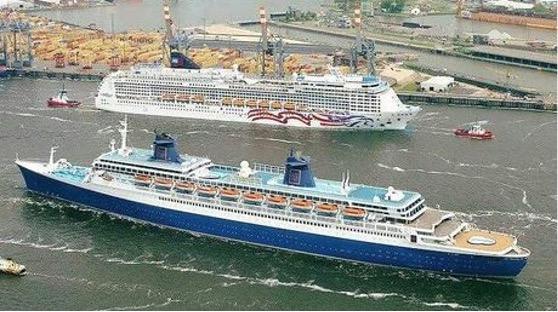
Another George, George S. sailed on the same ship twice. He told me: “In 1974, I crossed the Atlantic on the France. Ten years later, in 1984, I cruised the Caribbean on the Norway. Yes, it was the same ship — but with a different name. But to me, they were two different ships!”

The French Line’s France at Le Havre. Courtesy of the William H. Miller Collection. The Norway, formerly the French Line’s France, at Bremerhaven with Pride of America behind. Courtesy of the William H. Miller Collection.

Tragic Demise
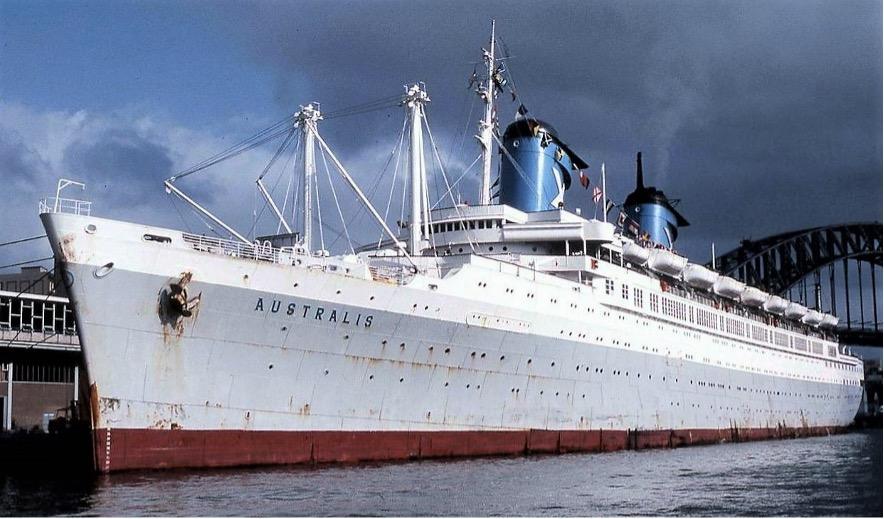
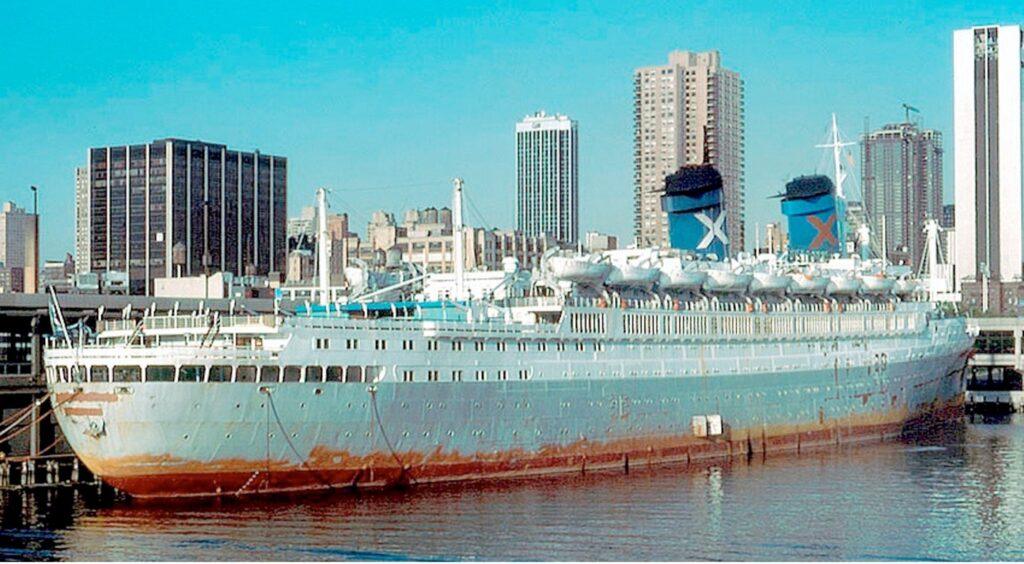
The 1940-built America was one of the finest liners on the trans-Atlantic run between New York and Northern Europe (to Cobh, Le Havre, Southampton and sometimes Bremerhaven). Owned by the Manhattan-based United States Lines, the ship was sold off to the Greek-flag Chandris Lines in 1964, becoming the Australis (for Europe-Australia service mostly). It left service in 1979 and then, and after several name changes, it was sold off (in 1992) to become a floating hotel out in far-off Phuket in Thailand. The 33,500-ton ship was especially renamed American Star.
The United States Lines’ America outbound from New York, seen from Independence. Courtesy of the William H. Miller Collection. A vintage United States Lines advertisement promoting travel to Europe aboard America. Courtesy of the William H. Miller Collection. The former United States Lines liner America at Sydney as Chandris Lines’ Australis. Courtesy of the William H. Miller Collection. A Chandris Lines advertisement promoting Australis as the line’s new flagship for service to the U.K. and Europe. Courtesy of the William H. Miller Collection. The former Australis, renamed America and idle at New York in 1978. Courtesy of the William H. Miller Collection.



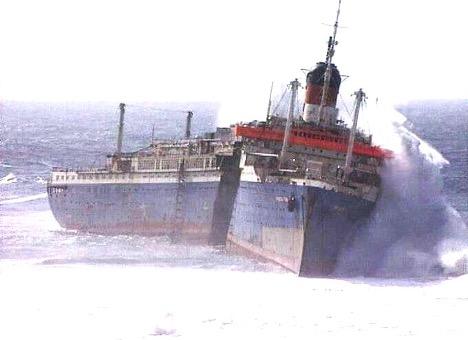
But strange are the fates! While being towed around the Canary Islands (and via South Africa to its new home in Thailand), the towlines snapped during a fierce storm and the ship drifted into the shoreline. Lashed by both waves and high winds, the abandoned liner broke in two.
The former America aground in the Canary Islands after breaking free from tow, where heavy seas later broke the ship apart. Courtesy of the William H. Miller Collection. The rusting forward section of the American Star remains stranded in shallow water off the Canary Islands. Courtesy of the William H. Miller Collection. The corroded bow of the American Star rises from the water off the Canary Islands, showing the severe deterioration of the stranded wreck. Courtesy of the William H. Miller Collection. A rusting section of the American Star wreck sits in shallow water off the Canary Islands. Courtesy of the William H. Miller Collection.
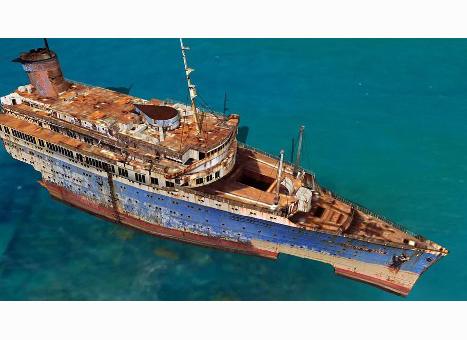
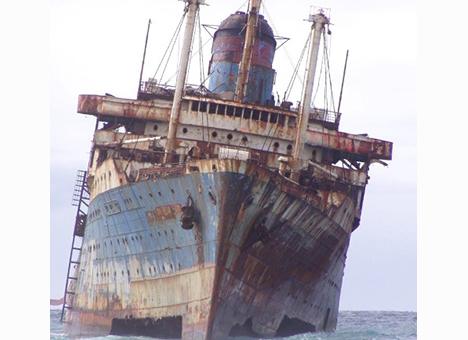
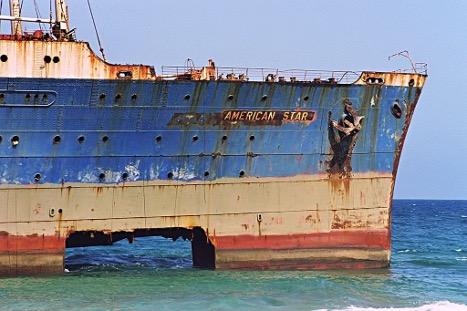
The ship decayed and eroded.
Finally, the forward section fell into the sea and the former America/Australis was gone forever.


