Remembering Arcadia, Iberia, Ivernia & the Great Transatlantic Liners
First Cruise
“My mother had just lost my father and so she decided we should do a cruise, my first,” recalled Eugenia from London.“It was aboard a wonderful ship called the Saga Rose [the former Sagafjord]. The ship had this great atmosphere, a charm, a warm comfort. It was like an old, seaside hotel. We cruised to Scandinavia and it was so scenic – the incredible fjords.”

LIVES OF THE LINERS: The Arcadia & Iberia
Like Cunard, P&O is one of the greatest and most historic names in shipping. Dating from 1837, and again like Cunard, this company remains in business but as part of the mighty Carnival Corporation. Today, they operate as many as eight passenger liners as P&O Cruises.

After World War II, P&O had to replace wartime losses and began building new liners, large, fast and well appointed ships. This began with the 1,159-passenger Himalaya in 1949. The Chusan followed in 1950, but purposely for P&O’s UK-Far East service. The Company’s “sensations” arrived in 1954 in the form of the 29,700-ton near-sisters Iberia and Arcadia. These ships joined the Orient Line passenger ships on the mainline run to Australia – London/Southampton, Gibraltar, Port Said, Aden, Bombay, Colombo, Fremantle, Melbourne and Sydney. After 1954, voyages sometimes continued to Auckland, Wellington, Fiji, Hawaii and then up to the North American West Coast, to Vancouver, San Francisco and Los Angeles. Some voyages were routed to/from London/Southampton via Bermuda, Nassau, Kingston, the Panama Canal and Acapulco.
Unlike the Orient Line, P&O also ran a passenger service to the Far East.

P&O’s Arcadia dressed with signal flags, showcasing the classic profile of the 1954-built liner. Courtesy of the William H. Miller Collection. P&O’s Arcadia maneuvers in Sydney Harbour, with the Sydney Opera House in the background. Courtesy of the William H. Miller Collection. P&O’s Iberia lies at anchor off Suva, Fiji, dressed with signal flags. Courtesy of the William H. Miller Collection. A 1977 P&O Pacific Cruises brochure features Arcadia at sea under the slogan “Let yourself go with P&O.” Courtesy of the William H. Miller Collection. A period P&O brochure promotes Iberia, highlighting the 1954-built liner’s interiors, open decks and 22-knot service. Courtesy of the William H. Miller Collection.


Stuck
Marianne told me that her family decided to move to Ireland in 1961. “We decided to move as much as we could and so went by ship. We had lots of luggage! We sailed from Montreal on the Cunard Line, on the Ivernia. But it was December. It was very, very cold. There was lots of ice in the St. Lawrence River and the ship was not only slowed but actually stuck for a time. The voyage was delayed – we were 2 days late arriving at Cobh. The voyage across was stormy – and my sister and I spent lots of time in our stateroom, which I seem to remember was down on C or D deck. We read to one another to pass the time.”

Update
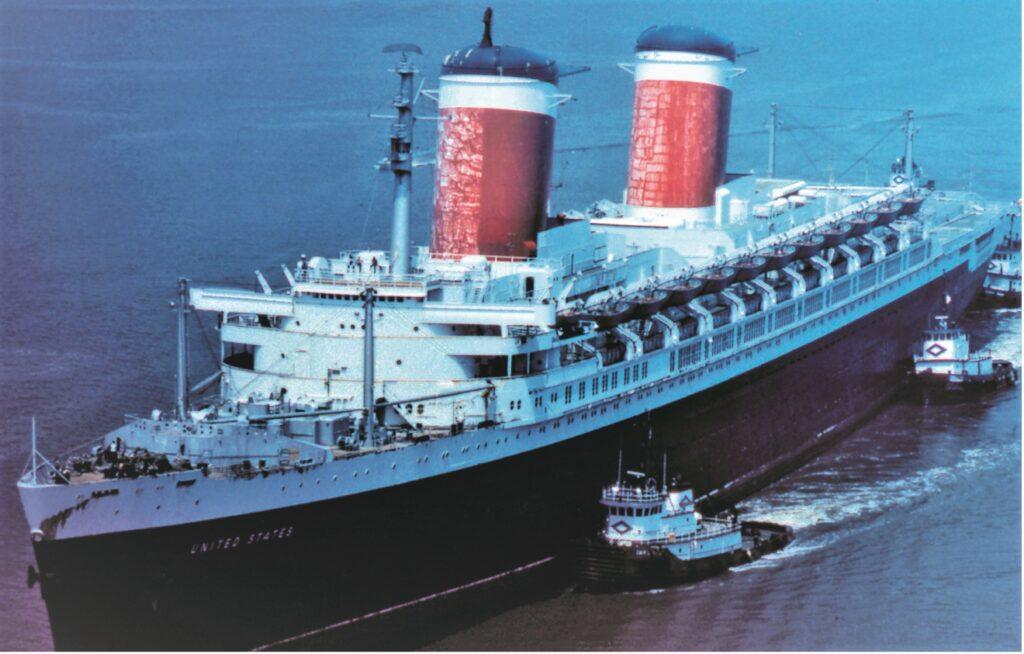
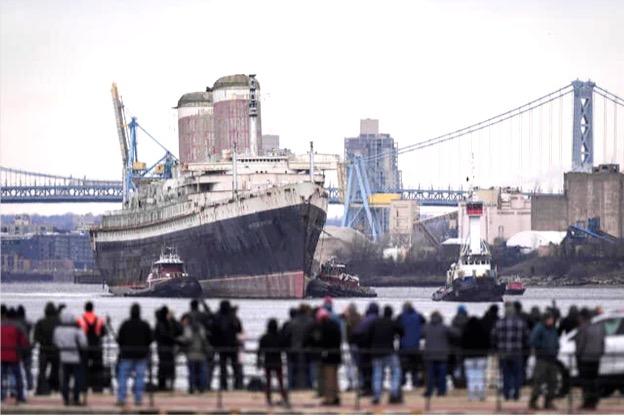
Charles D. is an historian and shipping expert. On July 19, he reported to us: “Still no definitive final closure on the SS United States. From what I understand, all the various agencies that need to sign off will apparently consolidate their input with the Army Corps, etc and will deliver a single package to Okaloosa County. Could happen by the end of the month and start a 30-day window for tow plans and Coast Guard OK to a sinking date. Practically speaking, no earlier than 1 September. Meanwhile the Army’s Section 106 review is done and seems to have been closed out. All the work aboard is focused on clearing scrap metal and opening or closing areas for diver access and safety.”
An aerial view of New York’s passenger piers in 1965, with United States, France, Queen Mary and Atlantic berthed together. Courtesy of the William H. Miller Collection. The United States heads for drydocking at Norfolk in May 1980, assisted by tugboats. Courtesy of the William H. Miller Collection. The United States leaves Philadelphia under tow for Mobile, watched by crowds along the Delaware River. Courtesy of the William H. Miller Collection.

Celebration
Margaret, a fellow passenger told me: “When I graduated from college in 1962, my father took our family on a trip to Europe. We sailed over on the Independence. Just sailing from New York on a beautiful June morning was a highlight – music, paper streamers, the sound of the ship’s whistles. We had smooth seas all the way to Naples – and then up to Rome and traveling through lots of Europe. We returned in August, but from Genoa and on the Constitution. Wonderful memories – a summer in Europe!”

Red, White & Blue
Robert C. sailed with the United States Lines beginning in 1960. “I was a cabin steward – first down in tourist class, then cabin class and on my last two trips in first class. First class was the really big tips — $50 and $100 bills were common. I began on the America and then was moved onto the United States. They were great ships – well run, well served and always immaculate. Even the crew quarters shined. I also did one voyage on a US Lines’ freighter, the American Clipper. We sailed from New York to Liverpool and Manchester. And we carried 12 passengers.”

West Side Piers
“My father was a New York docker,” said Jim M. “He worked on the Cunard Piers, 90 and 92 at West 50th Street. He knew all the Cunard ships: the Queens, the Mauretania, the Caronia. He saw many of the celebrities who were sailing back then and the elderly millionaires going around-the-world on the Caronia. But things began to change: Cunard later [in 1963] cut sailings and so was reduced to only Pier 92.”

Round the World
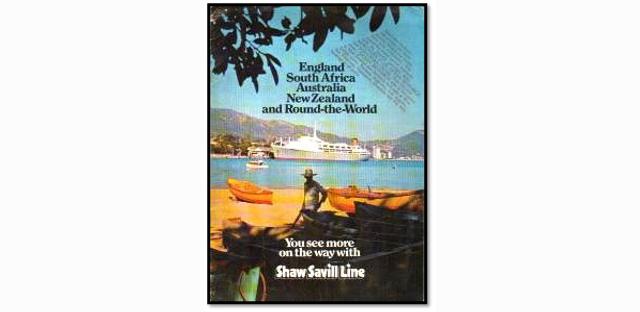
A fellow passenger told me: “I had an auntie, who did not marry until she was 65. As I remember, she wasn’t the happiest person. But when she finally married, she and her husband decided to go around-the-world. She’d barely ever left England, but decided finally to travel, really travel. They took the Northern Star [Shaw Savill Line] and made, I think, a 10-week trip. They left from and then returned to Southampton. But it seems it wasn’t the happiest trip for her. She was often seasick. And the ship was full of 10 pound Poms [migrants] going out to Australia — and then returned with lots of young, party-loving, noisy Australians. My auntie might have taken a cruise or two after that trip, but she was not fond of ocean travel.”
Shaw Savill Line’s Northern Star at dock. Courtesy of the William H. Miller Collection. A Shaw Savill Line advertisement promotes voyages linking England, South Africa, Australia and New Zealand, including round-the-world travel. Courtesy of the William H. Miller Collection.