

Ocean Liners, Stormy Crossings & Wartime Escapes Across the Atlantic
LIVES OF THE LINERS: The Argentina, Libertad & Uruguay
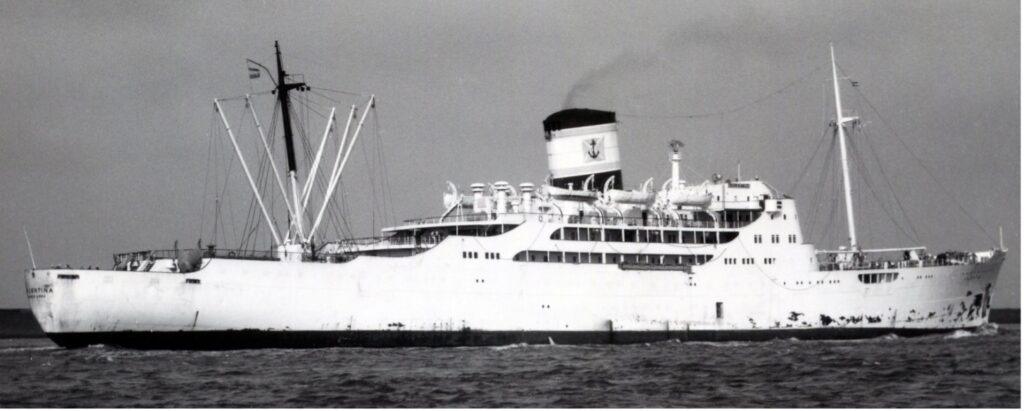
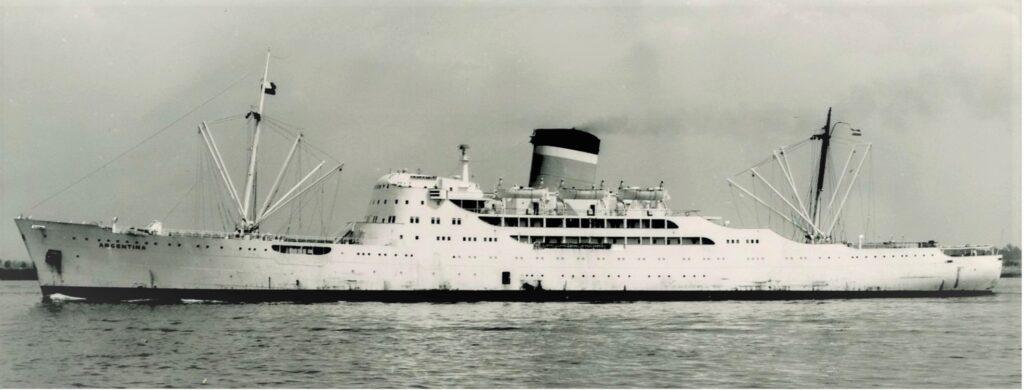
They were three splendid ships – the Argentina, Libertad and Uruguay – and among the finest in South Atlantic service.
This fine trio offered all-first class service (in the 1950s and 60s) between London, Le Havre and Lisbon to Rio de Janeiro, Montevideo and Buenos Aires. London to Buenos Aires was timed to 16 days. Carrying up to 96 passengers, accommodations included partial air-conditioning, an outdoor pool and all staterooms with private bathroom facilities. The ships were operated by Buenos Aires-based Dodero Line.

The Presidente Perón, later renamed Argentina, underway during her South Atlantic career. From the William H. Miller Collection. The Argentina, one of Dodero Line’s trio of all-first-class ships serving the South Atlantic route. From the William H. Miller Collection. The Argentina in profile, one of the three Dodero Line ships linking Europe with South America. From the William H. Miller Collection.

Mailbox
In the wake of our recent posting on the New Zealand Shipping Co,, Dave S. wrote: “Blimey, you have brought back some memories from long ago. I joined the other sister ship M/S Rangitane on 28 May 1960 at the Victoria Docks, London, and left her at the same docks on 21 September 1960. My job was to look after the Chief Purser and the Chief Steward. We went to New Zealand via the Panama Canal then to Tahiti, Fiji and then to Wellington, Port Chalmers (Dunedin) and Auckland and then headed for home. We stopped at Pitcairn Island to drop off the mail and some stores etc. We docked at Southampton to let the passengers off and then on to London.”

Dave added, “I also served on M/S Rangitiki from 17 Aug. until 25 Sept. 1961 as an assistant steward. I also served on a cargo ship of the New Zealand Shipping Company that was called SS Papanu from 12 Oct. 1960, I joined the ship in Falmouth (Cornwall). This was before I knew Pat [his late wife]. Happy days!”
More Mail
Dave H. added: “Des Cox [the late ocean liner historian and video maker] had a story about Rangitata. When he was Purser on her, he had a message from the Harbour Master to say that the United States was sailing early and would take Rangitata’s slot. Somehow, Des got waylaid and forgot to pass the message on to his captain. As a result both ships sailed at noon with the Rangitata slowly and smokily leading the United States down Southampton Water with the US’s skipper shouting through a megaphone to ‘Get that dam’ rust-bucket outta my way!’ At Calshot, the US turned to port and, luckily, the Rangitata to starboard and they parted with a friendly greeting!”

Stormy Passage
“In 1979, I crossed from Montreal to London on the Stefan Batory,” remembered another guest. “I think the bad weather began before sailed, at the pier in Montreal, and then continued (getting worse and worse!) for the entire trip. We were days late (I think it was four!) getting to London. It was a small ship, an old ship, a slow ship. I was traveling with my car, which was in the ship’s hold and offloaded by crane at the London (Tilbury) dockside.”

Anniversary
Ninety years ago today, the Queen Mary began its maiden voyage from Southampton traveling to New York at an average speed of 30 knots (34 mph). Then the largest liner yet built (at 81,000 tons), it went on to become one of the most beloved ocean liners ever. And one of the most heroic (together with the Queen Elizabeth): safely ferrying 2 ½ million troops during World War II.

Farewell Liverpool
“My father was an engineer and in 1962 he was contracted to go out to West Africa, to Nigeria,” recalled Tim C.J. “Our family sailed from Liverpool on a ship called Aureol. It seemed a big ship to me – and even had a swimming pool. We lived out in Nigeria for three years, but returned to England by air.”

Remembrance
“I was still a young boy in 1939, but I still remember vividly when my father took me down to the waterfront at New York, to see the great liners,” recalled Ken B. “It was the end of summer and the great Normandie was in port. Everyone knew the Normandie. It was the finest, most luxurious ship ever built – and beautiful looking too! But little did I imagine that this fantastic ship would never set sail again. It was laid-up [because of the uncertainty of war in Europe] and would later burn, capsize and be destroyed — and little more than two years later [Feb. 1942].”

Escape
A fellow passenger told me that her father, German-Jewish, managed to “escape” from Nazi Germany in the summer of 1939. He sailed to New York on the Bremen. But he worried very much until the ship reached New York and was safely at the pier. He thought that the Nazis might make the ship reverse course at any time and return to Germany and then arrest and imprisonment for him. But happily, he settled in Manhattan and did quite well as a furrier on West 37th Street.”


