

From Sail250 to Miami: Reconnecting With Peru Aboard B.A.P. Unión
Monday morning, I was out for a run through Maurice A. Ferré Park in downtown Miami when something rather difficult to miss appeared along the waterfront.
A four-masted tall ship.
Her towering masts and seemingly endless web of rigging rose above the waterfront. Most distinctive was an enormous red sail emblazoned with the white spiral of the Marca Perú logo.

Something about her looked familiar.
Very familiar.
Then it hit me.
New York Harbor. July 4th!
This was B.A.P. Unión, the Peruvian ship I had seen six weeks ago while watching NBC’s coverage of Sail4th 250 and America’s 250th birthday. I remember how her brilliant red sails popped against the harbor and among the parade of white sails.
And now, here she was in Miami.
And the more I learned about Unión, the more interesting the coincidence became. New York was only part of her remarkable American summer. She had participated in Sail250 events in New Orleans, Norfolk, Baltimore, New York and Boston.
Now she was making her final U.S. call, nearing the end of a nearly five-month voyage that began—and will end—in Callao, Peru.
Once I learned she was open to the public, there was no question.
I had to go aboard.
Unión’s Summer With Sail250
The Peruvian Navy formally calls Unión‘s deployment the Viaje de Instrucción al Extranjero 2026 (overseas training voyage), or VIEX 2026. She is under the command of Capt. Juan Roncagliolo Gómez.
Sail250 was a big part of that voyage.
Her participation began in New Orleans in late May, where the Peruvian Navy said she joined official Sail250 activities commemorating the 250th anniversary of American independence. She opened her decks and Casa Perú to the public before continuing to Norfolk and Baltimore.

On July 4, Unión joined an extraordinary international gathering of 80 tall ships and naval vessels in New York Harbor as the United States celebrated its 250th birthday. The official Sail4th 250 program called for the fleet to enter the harbor, pass in review and salute the Statue of Liberty.
This was the spectacle I had watched on television. As NBC announced Unión on-screen, her brilliant red Marca Perú sails lifted my eyes from my phone screen.
But Peru wasn’t simply sending a beautiful naval ship to an American birthday celebration.
The Peruvian Navy calls Unión the country’s “Embajada Itinerante”—its traveling embassy—reflecting her role in representing Peru’s maritime traditions, culture and international relationships. Through a partnership with PROMPERÚ, she also carries Casa Perú, an onboard showcase of the country’s tourism, culture and exports.
After New York came Boston, then Québec, before she headed south to Miami.

Like a Cruise Ship
B.A.P. Unión may look as though she sailed out of another century, but she is remarkably young. Built in Peru, the steel-hulled ship was launched in 2014. She measures 379 feet long and 44 feet wide, with a draft of about 21 feet. Her four masts rise as high as about 176 feet and carry 34 sails totaling roughly 36,600 square feet.
She is a naval vessel, of course. And I’m a cruiser. And, as i walked Unión’s decks, it was almost impossible not to think about the sailing ships that carry cruise passengers.
The comparison with Star Clippers is particularly striking.
B.A.P. Unión, Star Clipper and Star Flyer are all 379 feet long.
And despite their dramatically different missions, they carry almost the same number of people. Unión is making her 2026 voyage with 78 Peruvian Naval Academy cadets and a crew of 155, or 233 people aboard. Star Clipper and Star Flyer each accommodate 166 cruise guests with a crew of 74, or 240 people aboard.
That’s a difference of just seven people.

Their sailing rigs provide another surprising comparison. Star Clipper and Star Flyer each carry 16 sails totaling approximately 36,200 square feet. Unión carries more than twice as many individual sails—34—yet her total sail area is only slightly larger at about 36,600 square feet.
Same length.
Almost the same number of people.
Almost the same total sail area.
Completely different reasons for going to sea.

And the connections don’t end there.
Sea Cloud is another four-masted barque. Built in 1931, the historic sailing cruise ship measures about 359 feet long, carries 29 sails totaling approximately 32,300 square feet, and accommodates just 64 guests with a crew of about 60.
Windstar‘s Wind Star takes a more modern approach. The 440-foot, four-masted sailing yacht accommodates 148 guests with 105 crew and carries six self-furling sails totaling 21,500 square feet.

Then there is the newest—and most dramatic—example.
Orient Express Corinthian stretches 721 feet, making her nearly twice Unión’s length. Yet the ultra-luxury sailing yacht accommodates only 110 guests in 54 suites, served by 170 crew.
Her sailing technology could hardly be more different from Unión’s traditional rig. Three nearly 330-foot carbon masts carry three technologically advanced SolidSails, each covering approximately 16,150 square feet—roughly 48,400 square feet of sail area combined.

From the historic Sea Cloud and the traditional tall ships of Star Clippers to Windstar’s sailing yachts and the technologically advanced Orient Express Corinthian, sail remains very much alive in cruising.
Standing aboard Unión, that connection was difficult to miss – if you are a cruise nerd like me.
Walking the Decks of Unión
My visit didn’t venture deep into Unión’s working or living spaces. Much of the experience was a walk around her exterior decks and through Casa Perú.
But there was plenty to absorb.
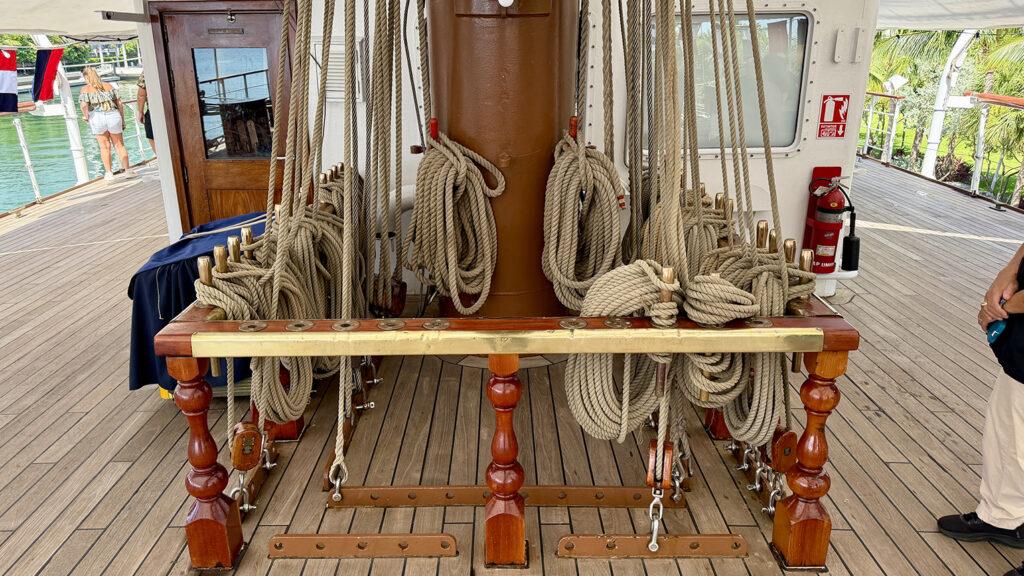
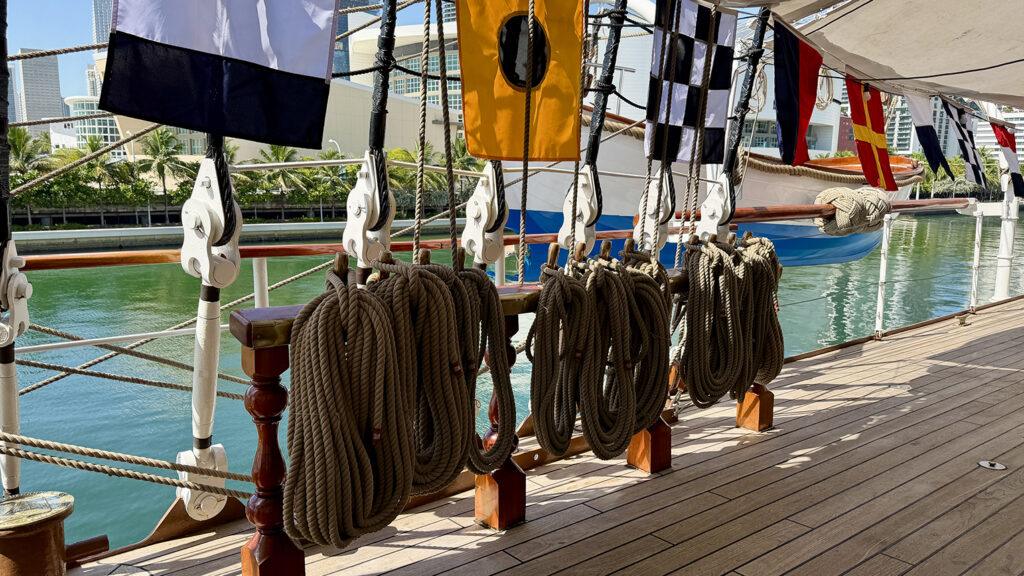
Standing beneath four towering masts and that elaborate web of rigging gives a much better appreciation for what a working tall ship actually entails. Lines descend seemingly everywhere, carefully organized around the deck. Traditional wooden blocks, pin rails, masts and yards coexist with the equipment of a modern naval vessel.
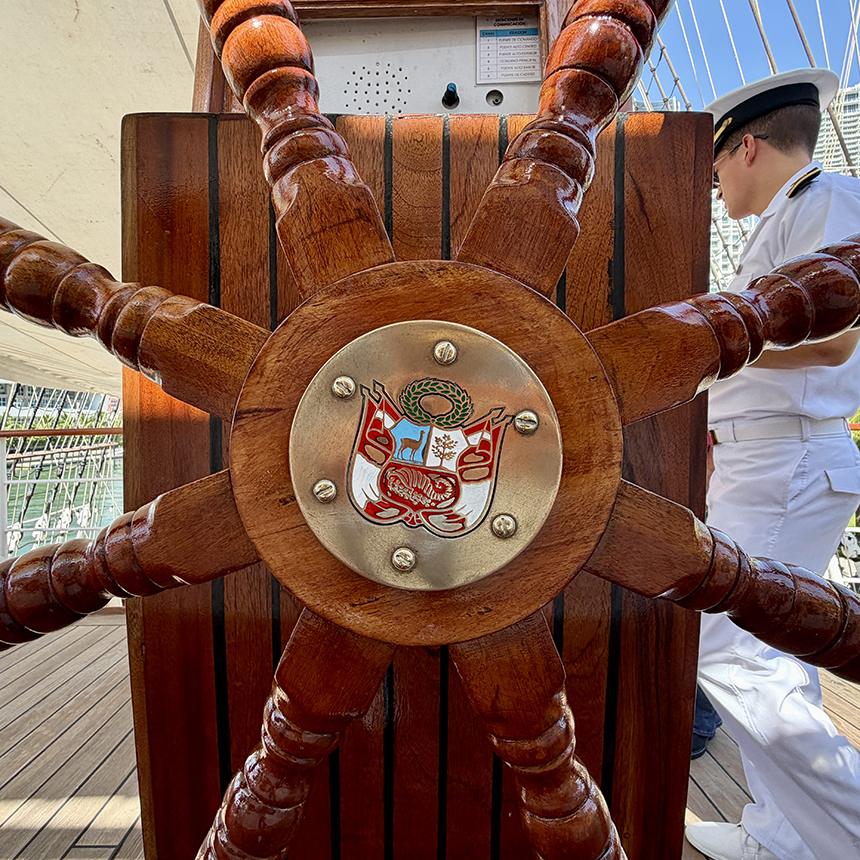
I climbed the steps to the raised forward deck and later the raised section aft, where a great wooden wheel immediately caught my attention.

A staged photo backdrop aboard B.A.P. Unión pairs the flags of Peru and the United States with the ship’s traditional wooden wheel. Photo: H. Liu Lines are neatly coiled around the mast and secured to belaying pins aboard B.A.P. Unión, part of the sailing ship’s extensive traditional rigging. Photo: H. Liu Coiled lines, wooden belaying pins and blocks form part of B.A.P. Unión’s traditional sailing rigging. Photo: H. Liu

The closer I looked, the more details emerged.
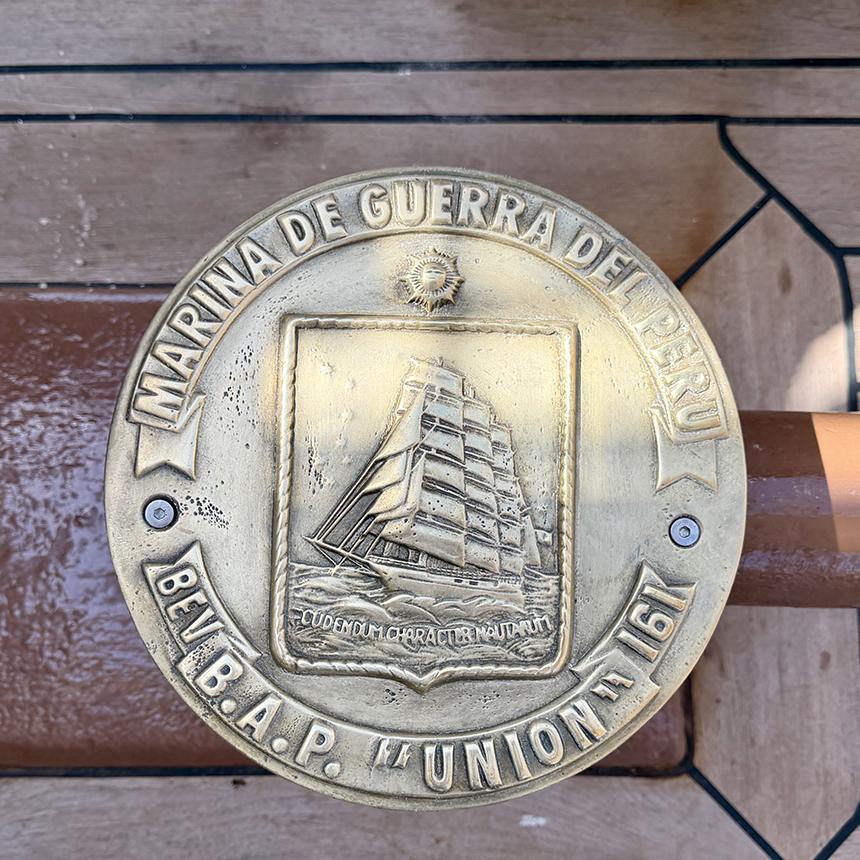
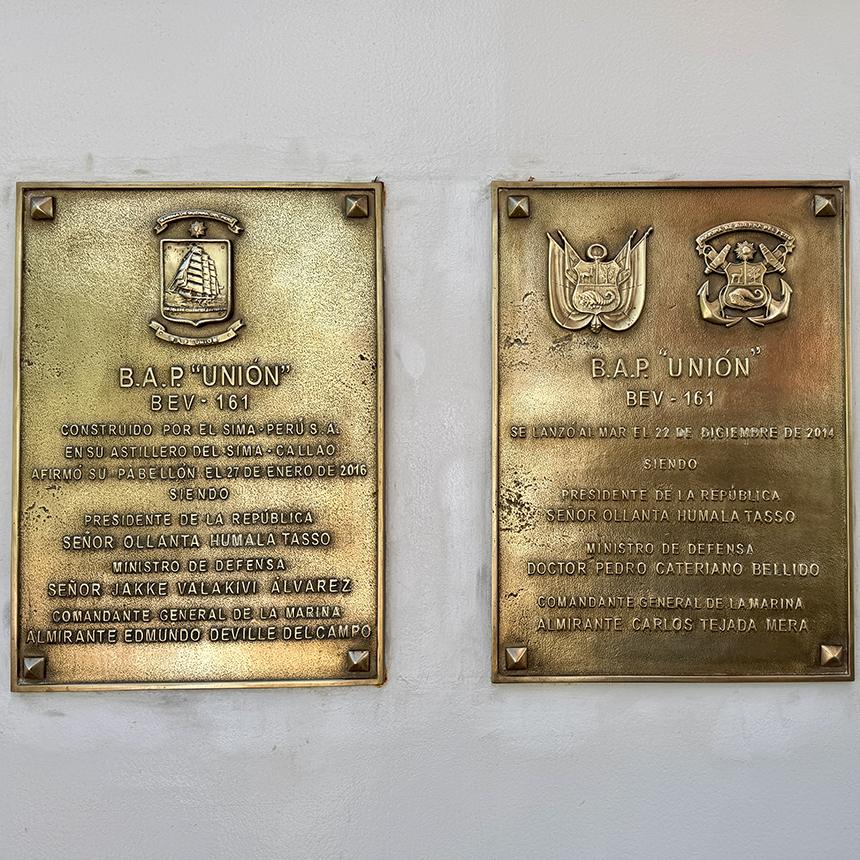
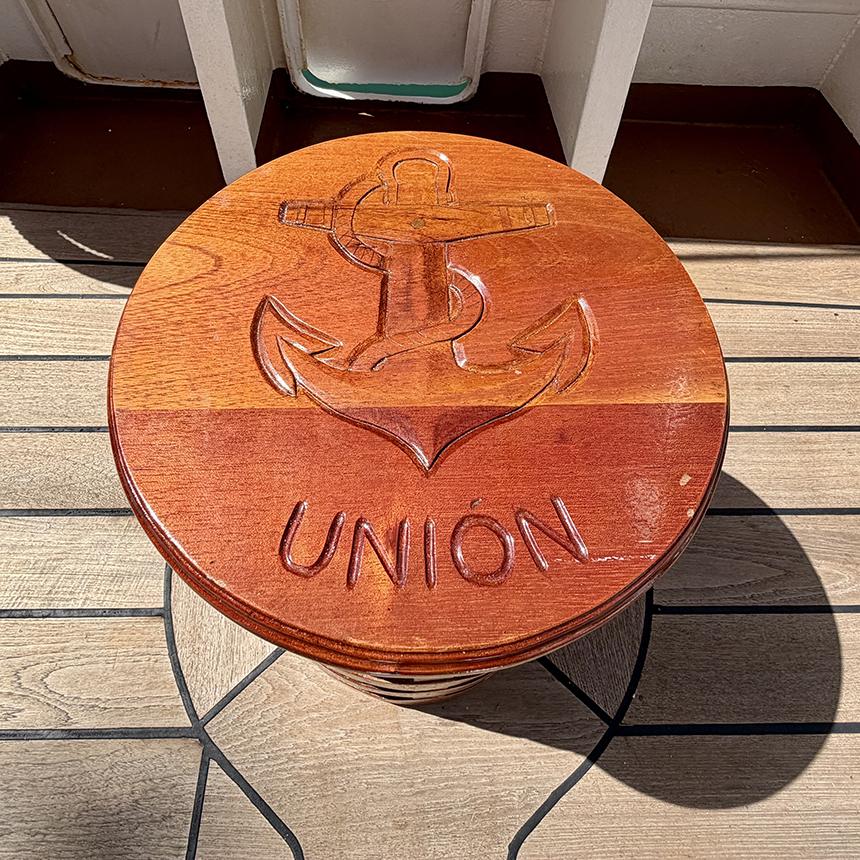
B.A.P. Unión was carved into wooden fittings. Bronze medallions carried images of the ship. Peru’s coat of arms sat at the center of the wheel.
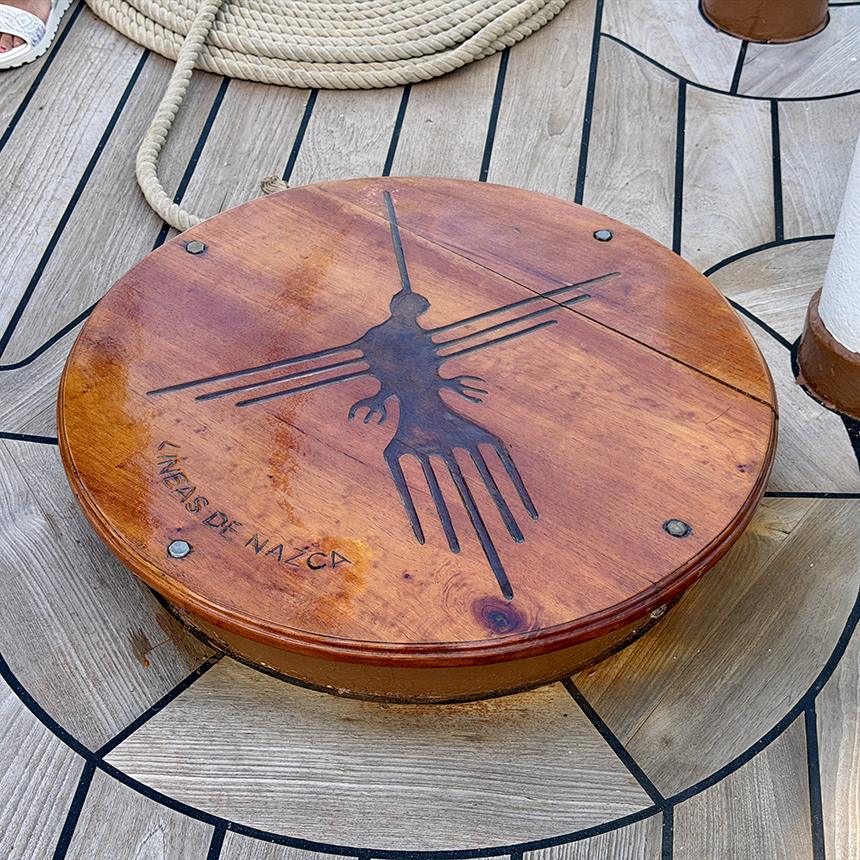
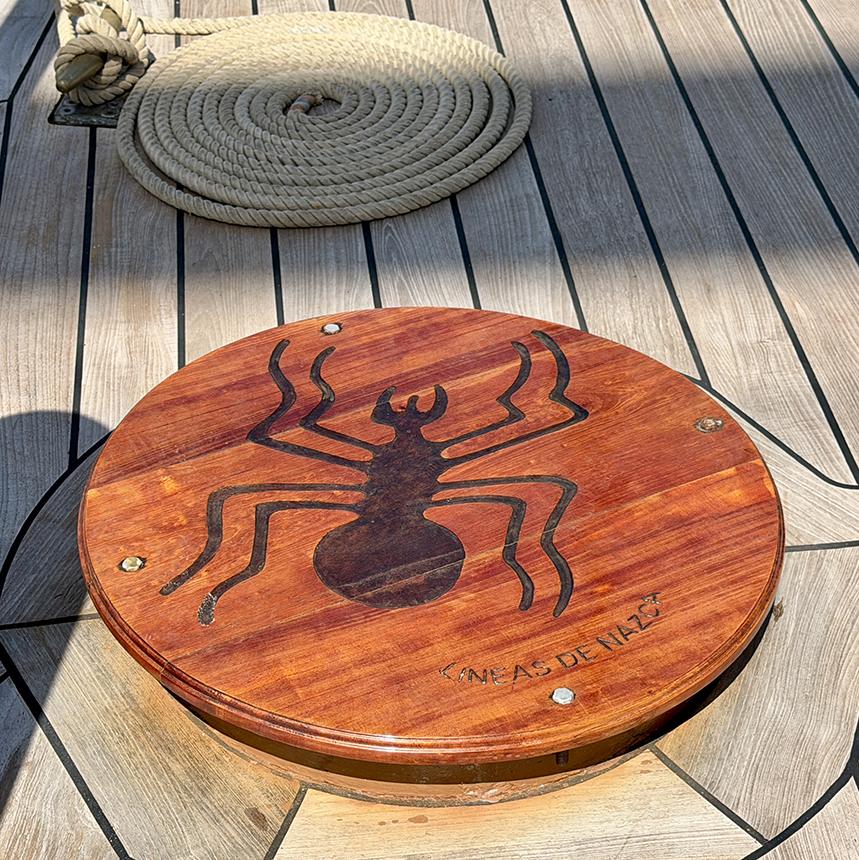
Even some of the round wooden covers on deck carried pieces of Peru. One was engraved with the famous hummingbird from the Nazca Lines; another depicted the spider.
A plaque aboard B.A.P. Unión identifies the Peruvian Navy sailing training ship as the “Itinerant Embassy of Peru,” a designation formalized in Callao in January 2021. Photo: H. Liu Peru’s coat of arms adorns the center of a traditional wooden wheel aboard B.A.P. Unión. Photo: H. Liu The famous hummingbird geoglyph from Peru’s Nazca Lines is depicted on a wooden deck cover aboard B.A.P. Unión. Photo: H. Liu The spider geoglyph from Peru’s Nazca Lines is depicted on a wooden deck cover aboard B.A.P. Unión. Photo: H. Liu A brass-topped capstan aboard B.A.P. Unión bears the emblem of the Peruvian Navy and an image of the four-masted training ship. Photo: H. Liu Bronze plaques aboard B.A.P. Unión commemorate the tall ship’s construction at the SIMA shipyard in Callao, Peru, and her 2014 launch. Photo: H. Liu A wooden deck fitting aboard B.A.P. Unión is carved with an anchor and the ship’s name. Photo: H. Liu

Her figurehead makes an even grander statement: the Inca ruler Túpac Yupanqui.

And above me was that enormous red Marca Perú sail –the same one that had caught my attention on television.

Throughout, cadets and crew welcomed visitors, posed for photographs and interacted with people moving through the ship.
Navy personnel welcome visitors aboard B.A.P. Unión during the tall ship’s public opening in Miami. Photo: H. Liu A Peruvian Navy crew member aboard B.A.P. Unión speaks with visitors during the tall ship’s public opening in Miami. Photo: H. Liu A Peruvian Navy crew member speaks with visitors aboard B.A.P. Unión during the tall ship’s public opening in Miami. Photo: H. Liu Visitors explore the forward deck of B.A.P. Unión during the Peruvian tall ship’s Miami call. Photo: H. Liu Peruvian souvenirs, crafts and B.A.P. Unión memorabilia are offered to visitors aboard the tall ship. Photo: H. Liu

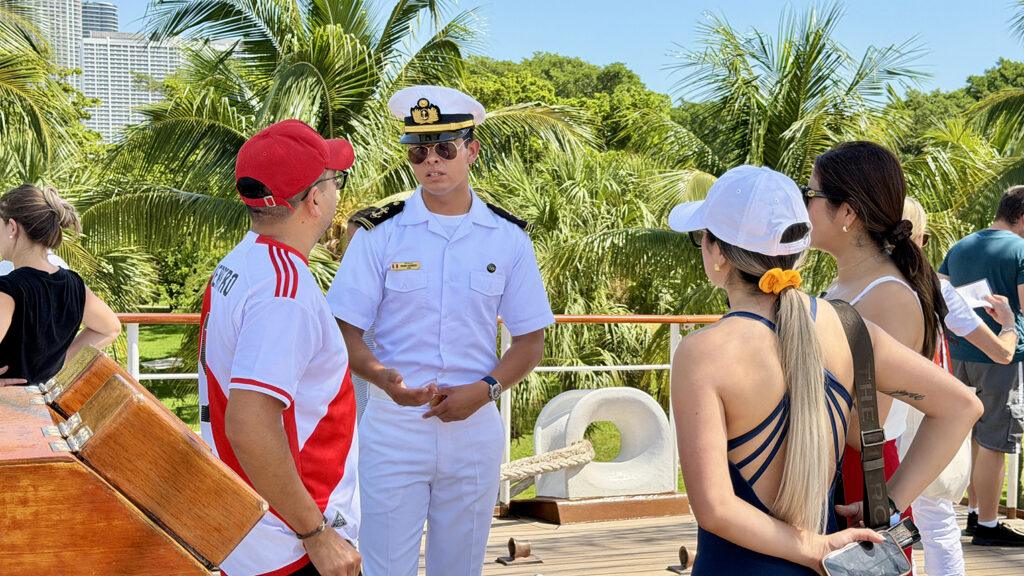
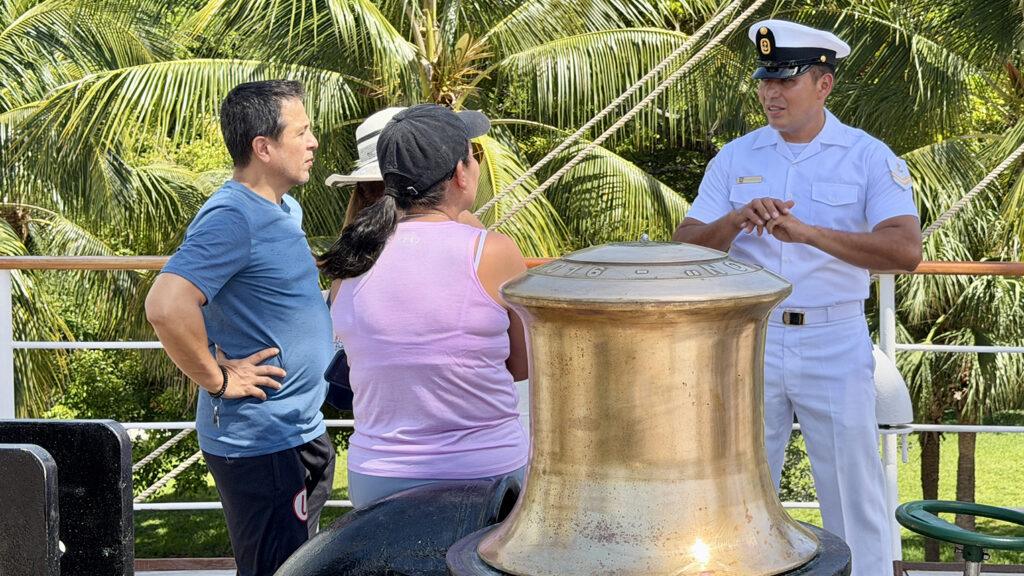
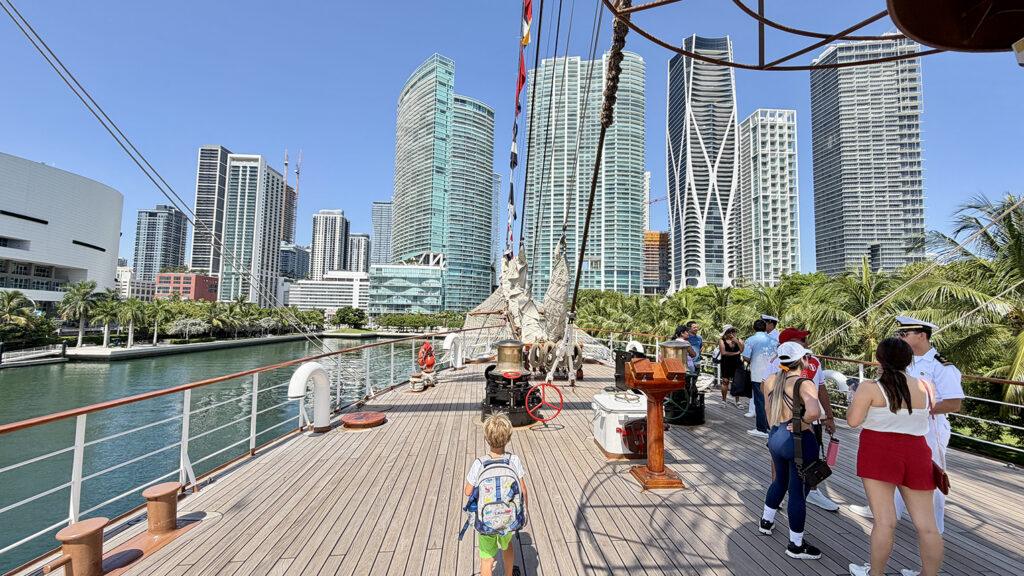
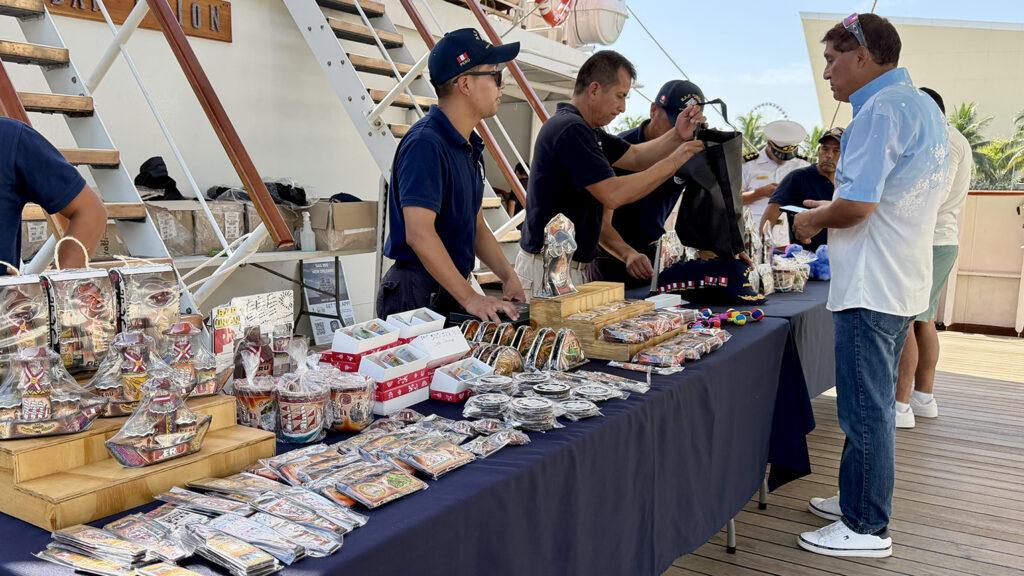
This was the same Unión that had welcomed tens of thousands of visitors during Sail250.
Now, in Miami, I was one of them.
And then I stepped inside Casa Perú.
There or Back to Peru
For someone who hasn’t been to Peru, Casa Perú offers an introduction.
For me, walking through it was something different.
Almost exactly two years earlier, I had been traveling through Peru myself. My friend and MBA classmate Nadia invited me to experience her country with her. What followed was an epic two-week journey through Peru, shared with friends and family along the way, and remains one of my favorite travel experiences.

Casa Perú was created by Mincetur and PROMPERÚ as a traveling showcase aboard Unión. This year’s exhibition uses the theme “Perú, país de experiencias únicas” — Peru, a country of unique experiences — and incorporates tourism, culture and Peruvian products into a single experience.
One display about alpaca immediately took me back to a traditional textile center in Peru’s Sacred Valley, where women demonstrated how alpaca fiber is worked and taught us about different grades—including wonderfully soft baby alpaca—and how to recognize authentic products. I left there with a pair of alpaca fingerless gloves and a matching baby-alpaca scarf, which I’ll finally take out of the bag if I ever go somewhere cold again.
Casa Perú showcases Peruvian tourism, culture and products aboard B.A.P. Unión, including displays devoted to Pisco and community-based tourism. Photo: H. Liu Casa Perú highlights alpaca fiber, textiles and Peru’s Andean textile industry aboard B.A.P. Unión. Photo: H. Liu Casa Perú aboard B.A.P. Unión showcases Peruvian fruits, grains, seeds and other export products during a ship’s visit to Miami. Photo: H. Liu Visitors explore Casa Perú, the onboard exhibition showcasing Peru’s destinations, culture and products aboard B.A.P. Unión. Photo: H. Liu


Seeing Casa Perú’s emphasis on community-based tourism brought that afternoon right back. I hadn’t simply bought gloves and a scarf. Someone had taken the time to teach me something about the people, craft and traditions behind them.
Then I spotted another familiar sight aboard Unión: Cusqueña.
That produced a different kind of smile. I’ve had Cusqueña before Peru, and I’ve certainly had it since. But there was something particularly satisfying about drinking it in Peru, which I did whenever the occasion reasonably called for one.

Perhaps that illustrates Casa Perú’s purpose better than simply listing what is displayed inside.
For someone who hasn’t visited, perhaps it creates curiosity about Peru.
For me, it brought back the Andes, the food and drink, the people we met and the experiences we shared during an extraordinary two weeks.
Last Call
Miami is Unión’s final U.S. call. And today is her final day in Miami.

But thinking back over the last 72 hours, after unexpectedly finding her in Miami, touring Unión’s decks and revisiting pieces of my journey inside Casa Perú, I find myself strangely reluctant to see her go.
I’ve already stepped aboard. I have the photographs. And now, you have the story.
But tonight, I’m going back.
Not for another tour. And not for another photograph…
Because tomorrow, she takes to sea again, crossing the Panama Canal, with two more scheduled ports—Guayaquil, Ecuador, and Salaverry, Peru—before arriving home in Callao on Sept. 24.


