

How Cruising Became the Easiest Way to See the World Alone
Most of the time, I travel alone.
This is not because I am heroic, mysterious, newly liberated, or trying to have an Eat, Pray, Love moment in a caftan. It is much more practical than that. My partner simply cannot pick up and sail every time a ship, itinerary, or assignment calls. So, if I want to keep seeing the world from the deck of a ship — and I very much do — I often go by myself.

When I first began my life as a solitary sailor, solo cruising felt like a rather small club. On any given voyage, there might be two or three of us who had shown up without a spouse, partner, friend, sister, brother, or bridge partner in tow. We were noticed, sometimes kindly, sometimes curiously, and occasionally with that faintly pitying look people reserve for someone eating dinner alone in a restaurant.
How quaint that seems now.
Solo travel has moved from the margin to the mainstream. Grand View Research valued the U.S. solo travel market at $94.88 billion in 2024 and projected it would grow at a compound annual rate of 12.4% from 2025 to 2030. Globally, the same firm put the solo travel market at roughly $549.8 billion in 2025, with projections that it could grow to more than $1.6 trillion by 2033. In other words, this is not a lonely little corner of the travel business anymore. It is a movement, and cruising is increasingly one of its most natural homes.
Why Cruising Works So Well for Solo Travelers
The appeal is easy to understand. Cruising solves many of the problems that make solo travel daunting. Your transportation, hotel, dining, entertainment, housekeeping, and itinerary are all folded into one floating address. You unpack once. You know where dinner is. You know where your bed is. You know that tomorrow morning, without decoding a train schedule or arguing with a rental car company in another language, you will wake up somewhere new.
For a solo traveler, that is not a small thing. It is liberation with a room steward.
There is also the built-in rhythm of shipboard life. A cruise gives you company when you want it and privacy when you don’t. You can have breakfast alone with a book, join a walking tour by ten, find yourself in conversation over lunch, disappear to your cabin for a nap, and reemerge for dinner looking as though you have been sociable all day. Cruising lets you manage solitude rather than be managed by it.

That may be why so many of us who cruise alone are not actually “alone” people at all. We have partners, families, jobs, friends, obligations, households, calendars, and lives filled with other people. We simply travel independently because life does not always hand us a companion with matching availability, matching curiosity, and matching stamina for shore days that begin at 8:30 in the morning.
You Are Rarely Alone Unless You Choose To Be
Dining used to be the greatest anxiety. Would I be seated at a table for one under a spotlight? Would I be placed with strangers who would spend the evening asking why I was traveling by myself? Would I become the ship’s designated oddity somewhere between the appetizer and dessert?
In practice, the opposite is more often true. Shared tables can become wonderfully easy places to meet people. So can lounges, lectures, cooking demonstrations, trivia, wine tastings, and, most reliably of all, shore excursions. Put a group of travelers on a bus, hand them all the same guide, point them toward a cathedral, vineyard, waterfall, fort, or food market, and conversation begins almost automatically. By the time you have all survived the same cobblestones, weather, staircase, or “short walk” that was nothing of the kind, you have something in common.
Shore Excursions, Safety, and the Comfort of Structure
That is why shore excursions deserve a place in any discussion of solo cruising, even if they are not the whole story. Shore Excursions Group, founded in 2008 and based in Plantation, Florida, offers more than 4,000 independent excursions in more than 350 ports worldwide. Its small-group model, vetted local operators, and guided logistics can be especially useful for travelers who want to explore beyond the ship without feeling entirely on their own. For a solo traveler, a good excursion can be both a doorway into a destination and an easy way to meet people without having to perform that ghastly cocktail-party maneuver of walking up to strangers and pretending it feels natural.
Safety matters too, particularly for women traveling alone. One of cruising’s great advantages is that the ship becomes a secure base. You can explore a city, take a tour, wander a market, or spend the day ashore knowing that your cabin, dinner, familiar crew, and a scheduled departure are waiting for you. That does not replace common sense, but it does provide structure. The Georgetown Institute for Women, Peace and Security’s 2025/26 Index ranks 181 countries on women’s inclusion, justice, and security, with Denmark, Iceland, Norway, Sweden, and Finland among the leaders. Many highly ranked countries are already staples of cruise itineraries, especially in Northern Europe, Iceland, the Baltic, and beyond.

Cruise Lines Are Paying Attention
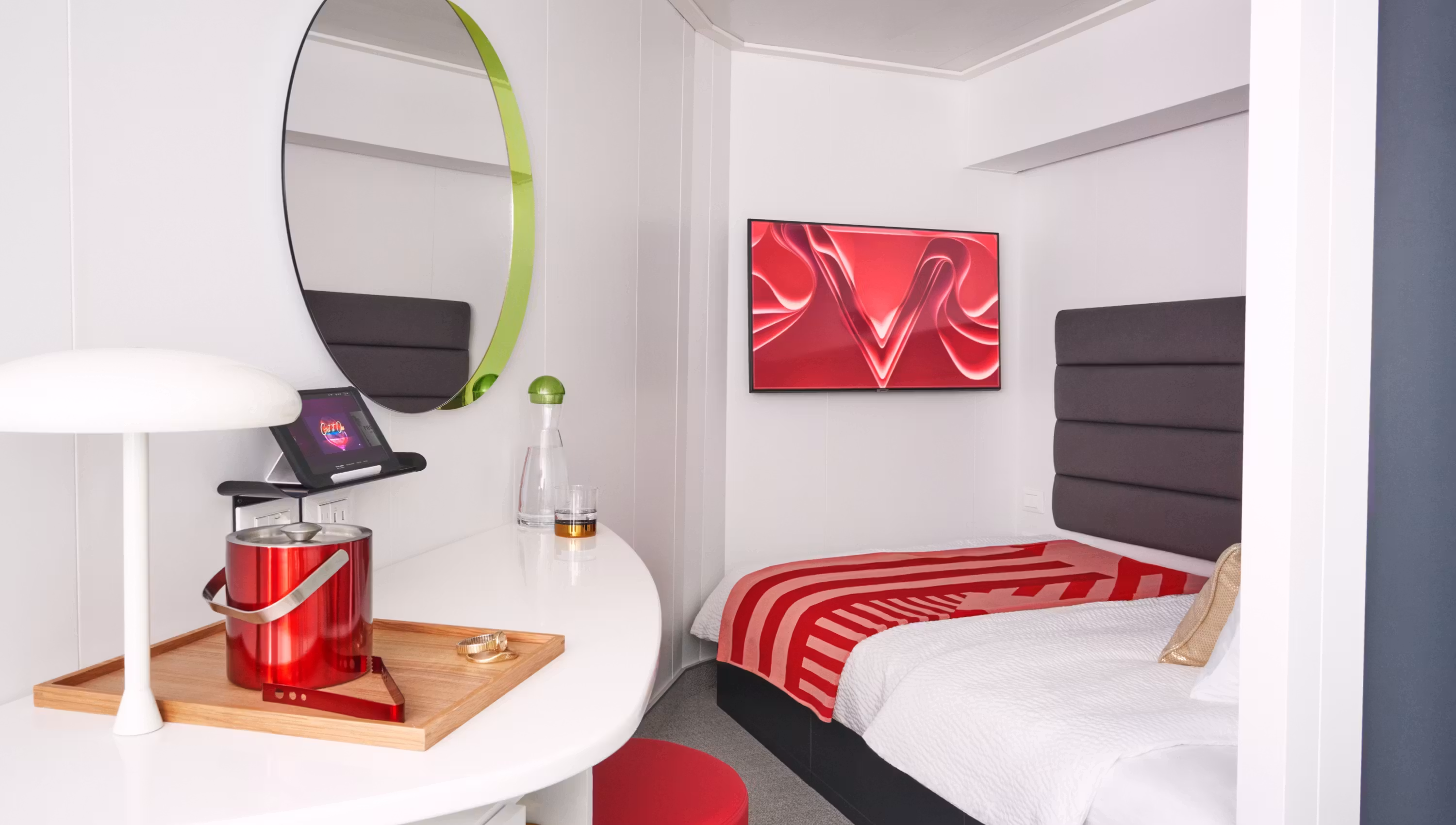
Norwegian Cruise Line has long been identified with solo cabins and studio lounges, while Oceania offers studio staterooms on select ships. Holland America Line is now making one of the more interesting moves by adding 30 purpose-built Solo Verandah staterooms to Oosterdam as part of its fleetwide “Evolution” project. These are single-occupancy balcony cabins with private verandahs and dedicated workspace — a welcome acknowledgment that solo travelers do not necessarily want to be tucked away in an inside cabin simply because they are traveling without a companion. Oosterdam is the first ship to receive them, with the broader fleet update to follow. And American Cruise Lines single accommodations are positively palatial if you want to sail closer to home.

None of this means the dreaded single supplement has disappeared. It has not. Solo travelers still learn to watch fares carefully, pounce on reduced-supplement offers, and decide whether a dedicated solo cabin is a genuine bargain or merely a cleverly designed broom closet with mood lighting. But the direction is unmistakable. The industry sees us now.
For me, with apologies to my dearly beloved partner, the pleasures of traveling solo are now obvious. I can follow my own curiosity. I can linger anywhere without apologizing. I can skip the bicycle tour. I can eat lunch when I am hungry, write when I need to, retreat when I am done being charming, and stand on deck as long as I like while a river, coastline, or harbor slides by.
There is also something bracing about arriving alone in a new place. You notice more. You listen better. You become more available to the day because you are not constantly negotiating it with someone else. The world comes at you more directly.

When I first began cruising solo, I sometimes felt like an exception. Now I feel like part of a much larger wave. Ships are adapting. Excursions are adapting. Travelers are adapting. The old assumption that a cruise passenger must come in pairs is beginning to look as dated as assigned deck-chair steamer rugs.
And thank heavens for that.
Because sometimes the person most ready to go is you. The ship is sailing. The world is waiting. And if your partner cannot pick up and join you, that is no reason to stay home.
Meanwhile, I’m delighted that my partner will join me as my plus-one on Viking Vesta in late August. If you’re a solo traveler looking for company, we’d be happy to meet you.


